

PA single uninsured assault claim can easily reach $250,000 to $500,000 when you factor in medical expenses, legal defense, lost wages, and pain-and-suffering damages. Jury awards in nightclub assault cases have exceeded seven figures with increasing frequency. Without A&B coverage, those costs come directly out of your business assets, and for most bar owners, that means closing the doors permanently.
The Role of the Customer's Personal Auto Policy
A single punch from a bouncer outside a nightclub can cost a venue owner millions, even if that bouncer technically works for a third-party security company. That reality catches a lot of nightclub and bar owners off guard. They assume outsourcing door security to a contractor shields them from liability, but courts across the country have been punching holes in that assumption for years. Nightclub crowd control failures and the vicarious liability exposure they create represent one of the fastest-growing cost centers in hospitality insurance. Negligent security litigation is the fastest-moving liability exposure in physical security, and the financial consequences of an underfunded security program are ultimately priced into your premiums, your verdicts, or both. With the U.S. bar and nightclub security workforce sitting at roughly 18,200 guards in 2026 and jury awards climbing sharply, venue owners who don't understand how liability flows from a contractor's employee back to them are sitting on a financial time bomb. This piece breaks down where the legal exposure actually lives and what you can do about it before a lawsuit does the teaching for you.
Understanding Vicarious Liability in the Nightlife Industry
Vicarious liability is the
legal principle that holds one party responsible for the actions of another, even when the first party didn't directly cause harm. For nightclub owners, this means a security guard's bad decision at the door can become your financial problem in court. The doctrine doesn't require you to have been negligent yourself: it's enough that you exercised control over the person who was.
The Legal Doctrine of Respondeat Superior
Respondeat superior, Latin for "let the master answer," is the backbone of most vicarious liability claims against nightclubs. If a court determines that a security guard was acting within the scope of their employment when they injured a patron, the employer bears responsibility. The tricky part for venue owners is that "employer" doesn't always mean the company that signs the guard's paycheck. A 2026 Virginia federal court found that security guards were misclassified as independent contractors because the hiring company maintained high operational control through GPS tracking and company-branded uniforms. The more you dictate how security does its job, the more likely a court views those guards as your employees for liability purposes.
When Bouncer Actions Become Owner Liabilities
The line between "contractor's problem" and "your problem" often comes down to control. If you're telling bouncers where to stand, how to handle ejections, what to wear, and when to call police, you're exercising the kind of operational control that collapses the independent contractor shield. Courts look at the totality of the relationship. A nightclub that provides radios, assigns posts, and sets behavioral standards for third-party security staff is functionally acting as an employer, regardless of what the contract says.
Common Crowd Control Risks and Negligence Claims
Most negligent security lawsuits against nightclubs fall into a few predictable categories. Understanding them is the first step toward not becoming a case study.
Excessive Force During Ejections
This is the claim type that generates the biggest verdicts. A bouncer uses a chokehold, slams a patron into concrete, or strikes someone who's already restrained. Juries don't respond well to these facts. A
jury verdict in a security guard assault case demonstrated how quickly liability and damages escalate when force is disproportionate to the threat. Even when a patron is belligerent, the legal standard asks whether the response was reasonable, and "reasonable" is a much lower bar than most bouncers think.
Inadequate Staffing and Overcrowding
Understaffing a 1,200-capacity venue with three bouncers on a Saturday night is a recipe for a negligence claim. California's fire code now requires venues with more than 500 attendees to staff one trained crowd manager per 250 persons, a role legally distinct from a standard security guard. Other states are watching California's model closely. If an incident occurs and your staffing levels were below industry norms, a plaintiff's attorney will use that gap as evidence of foreseeability.
Failure to Intervene in Patron Altercations
Owners sometimes face liability not because their security did something wrong, but because they did nothing at all. When a fight breaks out and security staff stand by or respond too slowly, the venue can be held liable for failing to maintain a safe environment. This is especially dangerous in states that apply the "prior similar incidents" test to foreseeability: if your venue has a documented history of fights, the duty to intervene becomes harder to deny.
Comparing Security Staffing Models and Insurance Impact
How you staff your security directly affects your insurance costs and your legal exposure. Here's how the three most common models compare:
| Factor | In-House Security | Third-Party Contractor | Hybrid Model |
|---|---|---|---|
| Control Over Training | Full | Limited | Moderate |
| Vicarious Liability Exposure | High (direct employer) | Medium-High (depends on control) | Moderate |
| Insurance Premium Impact | Higher base, but predictable | Lower base, but exclusion risk | Balanced |
| Misclassification Risk | None | Significant | Low-Moderate |
| Quality Consistency | Easier to maintain | Varies by vendor | Requires clear protocols |
| Typical Annual Cost (per guard) | $53,000–$55,000 fully loaded | $25–$40/hr contracted | Varies |
The hybrid model, where a venue employs a head of security in-house and contracts additional guards for peak nights, is gaining traction because it balances cost control with liability management. GrayStone Insurance Group's brokers, who average 20 years of experience in high-risk placements, often recommend this approach because it gives underwriters confidence that the venue maintains quality oversight without absorbing the full payroll burden.
How Worker Misclassification Multiplies Your Risk
One of the most underappreciated liability traps in nightclub security is worker misclassification. If you hire guards as independent contractors but treat them like employees, you face exposure on two fronts: vicarious liability for their actions and penalties for misclassification itself. The Virginia ruling mentioned earlier is a warning shot. Courts are increasingly skeptical of the independent contractor label when the hiring entity controls scheduling, appearance, and conduct protocols. If your "contractor" wears your venue's logo, follows your rules, and reports to your manager, a judge is likely to see through the paperwork.
Mitigation Strategies to Protect Your Assets
Risk elimination isn't realistic in nightlife. Risk reduction is. The strategies below won't make you bulletproof, but they'll make you a much harder target for plaintiff's attorneys and a much better risk for insurers.
Standardized De-escalation Training
Every security staff member, whether in-house or contracted, should complete documented de-escalation training before working a single shift. This isn't just good practice: it's evidence. When a lawsuit lands, the first thing a plaintiff's attorney requests is training records. If you can produce certificates, curricula, and refresher schedules, you've already weakened their negligence argument. Programs that include scenario-based role-playing tend to produce better real-world outcomes than lecture-only formats.
Incident Documentation and Video Retention
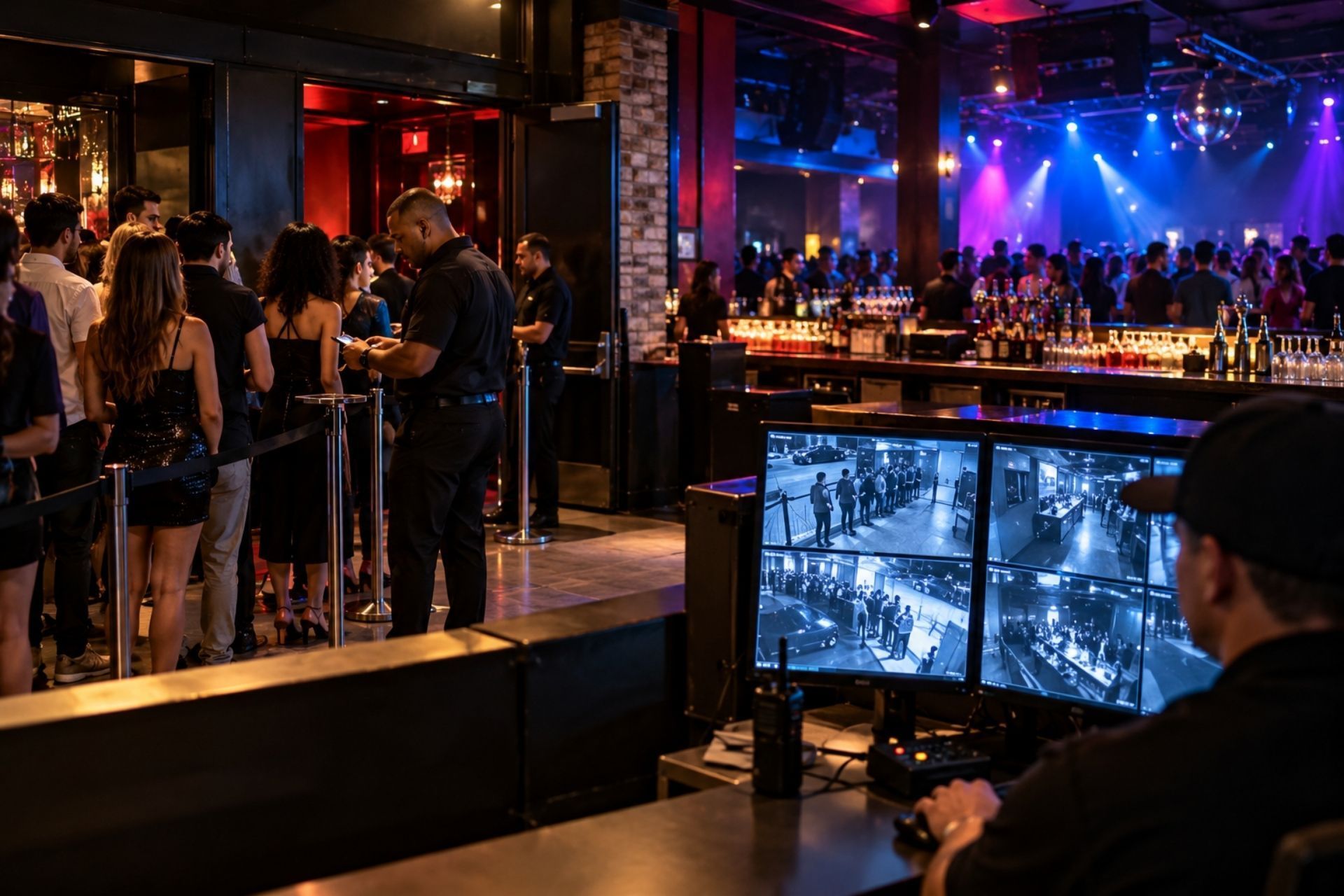
Your camera system is only as useful as your retention policy. A 90-day retention period for all surveillance footage is the recommended industry benchmark in 2026 to cover the discovery window for late-reported liability claims, with indefinite holds on any footage involving physical contact, ejections, or police response. One security industry observer put it bluntly: a camera that watches someone pull a weapon and does nothing until police review the tape
is not security but documentation. Pair your cameras with written incident reports completed the same night, and you've built a defensible record.
Common Questions About Security Liability
Does hiring a third-party security company protect me from lawsuits? Not automatically. If you exercise significant control over how the guards perform their duties, courts can hold you vicariously liable regardless of the contractual relationship. The contract helps, but your actual behavior matters more.
What's the difference between a crowd manager and a security guard? A crowd manager is a role defined by fire codes, focused on occupancy monitoring, egress management, and emergency procedures. A security guard handles access control and patron behavior. California now requires both for larger venues, and they're not interchangeable.
How much can a negligent security verdict actually cost? The median nuclear verdict for premises liability and negligent security in jurisdictions like Georgia has reached $24 million, accounting for roughly 25% of all such verdicts in the state. Even smaller claims routinely settle in the six-figure range.
Will my general liability policy cover a bouncer assault claim? Most GL policies cover bodily injury claims, but many include exclusions for assault and battery or cap coverage for such claims at a fraction of the aggregate limit. Read your policy's assault and battery sublimit carefully: it's often $25,000 to $100,000, far below what these cases actually cost.
Are my insurance premiums going up because of this trend?
Yes. Social inflation driven by shifting juror attitudes is fueling projected 15% to 30% premium increases for nightclubs with poor loss histories in late 2026.
Georgia's Tort Reform and the Foreseeability Standard
Georgia's 2025 tort reform introduced a "500-Yard Rule" that creates a geographic threshold for prior substantially similar crimes used to determine whether a venue owner should have foreseen a security incident. This matters because foreseeability is often the make-or-break element in negligent security cases. If a plaintiff can't show that similar crimes occurred within 500 yards of your venue, their case weakens significantly under Georgia law. Other states may adopt similar frameworks as legislatures respond to the nuclear verdict trend.
What Indemnification Clauses Actually Protect
Your contract with a security vendor should include an indemnification clause requiring the contractor to hold you harmless for claims arising from their employees' actions. But here's the catch: indemnification is only as strong as the contractor's ability to pay. If your security vendor carries $1 million in liability coverage and a verdict comes in at $5 million, you're on the hook for the difference. GrayStone Insurance Group uses AI-powered risk modeling to help venue owners evaluate whether their contractors' coverage limits actually match the exposure profile of the venue, a step most owners skip until it's too late.
The Real Cost of Reactive Security Programs
Reactive security, meaning you address problems only after incidents occur, is the most expensive approach over time. Every unaddressed risk becomes a data point that a plaintiff's attorney can use to establish a pattern of negligence. A venue that documents three fights in six months and doesn't increase staffing, improve training, or upgrade surveillance has essentially built the plaintiff's case for them. Proactive investment in crowd control infrastructure, training, and proper insurance coverage costs a fraction of a single six-figure settlement.
The Bottom Line for Venue Owners
The relationship between nightclub crowd control, your security contractors, and vicarious liability isn't something you can paper over with a boilerplate contract. Courts look at behavior, not just documents. They ask who controlled the guards, what training was provided, whether staffing was adequate, and whether the venue responded to known risks.
Venue owners who take security seriously, meaning documented training, proper staffing ratios, clear incident protocols, and insurance coverage that actually matches their risk profile, position themselves to survive both the lawsuit and the premium renewal. Those who treat security as a line item to minimize are the ones generating the nuclear verdicts that drive everyone's premiums up.
If your current insurance program hasn't been stress-tested against a negligent security claim scenario, that's the conversation to have now, not after a bouncer makes a split-second decision that costs you everything. GrayStone Insurance Group works with nightclub and bar owners across the country to structure coverage that accounts for these exact exposures, with brokers who understand the difference between a policy that looks good on paper and one that actually pays when it matters.
Search
INDEX

ABOUT THE AUTHOR:
CHAD KRAMER
I started GrayStone Insurance Group in 2018 with a simple conviction: the businesses everyone else turns away deserve a broker who won't. What began as a one-person operation has grown into a specialty commercial brokerage with offices across the country — but the mission hasn't changed. We find solutions for high-risk and hard-to-place businesses when other agencies run the other way.
I built this agency on integrity, hard work, and the tenacity to do the hard things well. Through our access to Excess & Surplus and specialty markets, my team and I place coverage standard carriers can't — and I treat every client's business like my own.
If you've been declined, non-renewed, or told your business is too complicated to insure, let's talk.