
General Liability responds to the core exposures most operations in this category face. A typical policy answers third-party claims and the defense costs that come with them, so a single incident doesn't put the business at risk.
Getting insurance for a painting business shouldn't feel like pulling teeth, but for most contractors, that's exactly what it is. Carriers see the word "painter" on an application and immediately start thinking about ladders, scaffolding, chemical fumes, and six-figure property damage claims. The result? Declined applications, sky-high premiums, or policies so riddled with exclusions they barely cover anything useful. If you've been through this cycle, you're not imagining things: painters insurance is genuinely one of the harder commercial lines to place, and it's been getting worse as property underwriters continue tightening their standards into 2026. The good news is that specialized brokerages exist precisely for situations like this. GrayStone Insurance Group has built its reputation around placing coverage for businesses that standard carriers won't touch, and painting contractors are a prime example. Here's why your industry gets flagged as high-risk and what you can actually do about it.
The Risk Profile: Why Carriers Are Hesitant to Insure Painters
Insurance carriers price risk based on historical claims data, and painting contractors generate the kind of claims that make underwriters nervous. It's not just one thing: it's a combination of property exposure, bodily injury potential, and environmental liability that stacks up fast.
Most painting businesses don't realize how their specific risk profile compares to other trades. A general handyman or a flooring installer presents a far simpler risk picture. Painters, on the other hand, work at heights, handle volatile chemicals, and operate inside clients' finished homes and commercial properties. That triple threat puts them in a category that many admitted carriers simply don't want to write.
Property Damage and High-Value Claims
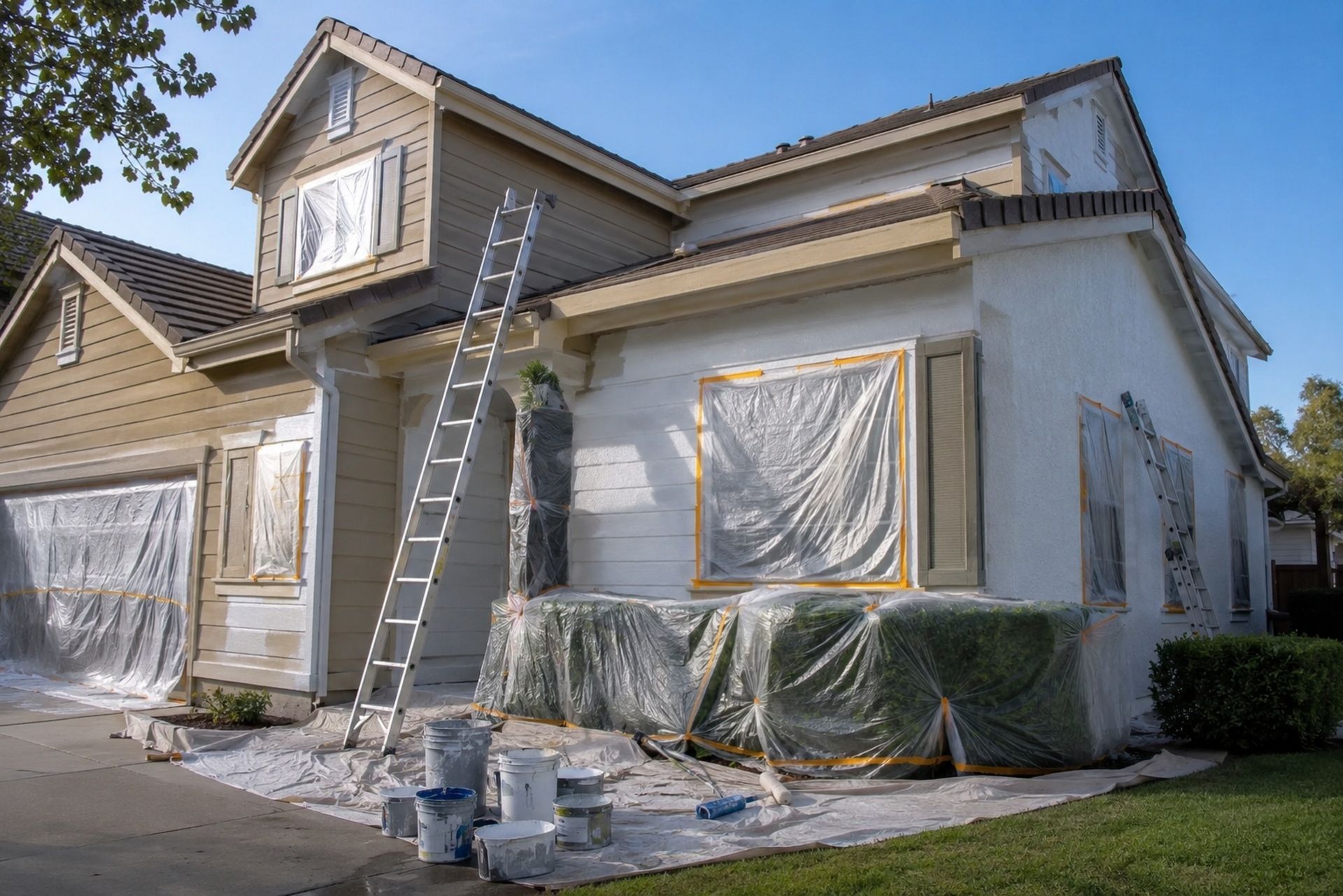
Think about what a painter actually does all day: they work inches away from a client's most valuable assets. A single spill on hardwood floors, an overspray incident on a neighbor's vehicle, or a pressure washer mishap on historic brick can generate claims in the $10,000 to $50,000 range without breaking a sweat.
The claims that really scare carriers are the ones involving interior work in high-end residential properties. A crew painting a custom-built kitchen accidentally damages imported Italian marble countertops, and suddenly you're looking at a $30,000 claim on a $5,000 job. These aren't hypothetical scenarios: they happen regularly, and carriers have the data to prove it.
Commercial painting jobs carry similar exposure. Overspray on a fleet of company vehicles parked in an adjacent lot, damage to specialized equipment in a manufacturing facility, or water intrusion from improper exterior prep work can all result in claims that dwarf the original contract value.
Worker Safety and Height-Related Risks
Falls remain the leading cause of death in the construction industry, and painters spend a disproportionate amount of their time on ladders, scaffolding, and lift equipment. Even interior painters regularly work from step ladders and extension ladders, and a fall from just six feet can cause serious injuries.
The 2026 construction insurance market outlook shows that workers' compensation costs for trades involving height work continue to climb. For a three-person painting crew, a single lost-time injury can spike your experience modification rate for three years, compounding your premium increases well beyond the initial claim.
Exterior painters face even steeper scrutiny. Multi-story residential work, commercial building exteriors, and bridge or structural painting all carry elevated risk classifications that push premiums higher and make many carriers decline outright.
Environmental Hazards and Chemical Exposure
Lead paint abatement, VOC exposure, and chemical disposal create a liability layer that most other trades don't deal with. Any painter working on pre-1978 structures faces potential lead exposure claims, and these can surface years or even decades after the work is completed.
Solvent-based products, epoxy coatings, and industrial-grade primers all carry health risks for workers and building occupants. A tenant who develops respiratory issues after an interior commercial paint job may file a claim against the painting contractor, and these claims tend to be expensive to defend even when the contractor followed proper protocols. Environmental cleanup liability adds another dimension: improper disposal of paint waste, even unintentional, can trigger regulatory fines and third-party claims.
INDEX
GrayStone Insurance Group is fully licensed and permitted to provide specialty commercial insurance solutions for high-risk and hard-to-place businesses across 17 states.
We proudly serve high-risk and hard-to-place businesses from coast to coast. As an independent specialty brokerage, our team works with leading Excess & Surplus and specialty carriers to make sure restaurants, bars, contractors, trucking companies, manufacturers, and other hard-to-place operations receive coverage that fits their real risks in California, Colorado, Florida, Georgia, Illinois, Iowa, Maryland, Michigan, Missouri, Nevada, New York, North Carolina, South Carolina, Tennessee, Texas, Utah, and Washington.
Every policy has boundaries. Knowing them up front is how you avoid an uncovered claim. Common exclusions include:
Every policy has boundaries. Knowing them up front is how you avoid an uncovered claim. Common exclusions include:
Every policy has boundaries. Knowing them up front is how you avoid an uncovered claim. Common exclusions include:
General Liability responds to the core exposures most operations in this category face. A typical policy answers third-party claims and the defense costs that come with them, so a single incident doesn't put the business at risk.
If your firm provides any design, engineering, or consulting services alongside construction, you need both. A GL policy won't cover a claim alleging your design specifications caused a building envelope failure. That's a professional liability exposure, and it's one of the fastest-growing claim categories in construction.
The GrayStone Advantage: Specialized Markets for Painting Contractors
Standard insurance agencies typically work with a handful of admitted carriers, and when those carriers say no to a painting contractor, the agent often has nowhere else to turn. That's where specialized brokerages make the difference.
GrayStone Insurance Group works specifically with hard-to-place risks, and their brokers average 20 years of experience in the insurance market. That depth of experience means they've seen every version of the "we can't insure painters" problem and have developed relationships with carriers who will.
Access to Non-Admitted and Surplus Lines
The surplus lines market exists for exactly this reason. When admitted carriers (the ones regulated by state insurance departments with standardized forms) decline a risk, surplus lines carriers can step in with customized policies that address the specific exposures a painting business faces.
GrayStone maintains access to a broad network of non-admitted carriers who specialize in contractor risks. These aren't fly-by-night operations: they're well-capitalized insurers who've chosen to focus on risks that the standard market avoids. The policies they write can include endorsements for lead paint work, height exclusion buybacks, and pollution liability extensions that you simply won't find on a standard commercial general liability form.
Their data-driven underwriting approach uses AI-powered risk modeling to match your specific business profile with the right carrier, which means faster quotes and more accurate pricing.
Custom Risk Assessments for Exterior and Interior Jobs
A residential interior painter and a commercial exterior painting contractor have vastly different risk profiles, but many carriers lump them together under the same classification code. This one-size-fits-all approach means interior-only painters often pay for risk they don't carry, while exterior contractors get declined because the carrier can't price their actual exposure accurately.
GrayStone's approach involves breaking down your operations by job type, height exposure, chemical usage, and client property values. This granular assessment means you're paying for the coverage you actually need, not subsidizing risks you don't have. A painter who exclusively handles interior residential repaints shouldn't be quoted the same rate as a crew doing industrial tank coatings, and the right broker ensures they aren't.
| Feature | General Liability (GL) | Professional Liability (PL) |
|---|---|---|
| What it covers | Bodily injury, property damage from your operations | Errors, omissions, or negligent professional advice |
| Example claim | A customer trips over your tools at a job site | You spec the wrong breaker panel, causing an overload |
| Trigger | Physical harm or damage | Financial loss from professional mistakes |
| Completed operations | Yes, typically included | Depends on policy form |
| Defense costs | Usually outside the limit | Often inside the limit (erodes coverage) |
| Typical cost | $800-$2,500/year for solo operators | $500-$1,500/year depending on revenue |
Essential Coverages for Every Painting Business
Knowing which policies you need is half the battle. The other half is understanding what each policy actually covers and where the gaps hide.
General Liability vs. Professional Liability Comparison
General liability covers third-party bodily injury and property damage: the spilled paint on a client's floor, the ladder that falls on a pedestrian, the overspray on a neighbor's car. It's the foundation of any painting contractor's insurance program, and the national average cost runs about $208 per month for a standard $1M/$2M policy.
Professional liability, sometimes called errors and omissions, covers claims arising from your professional advice or workmanship. If you recommend a specific paint product that fails prematurely, or if your color consultation results in a client claiming financial loss, professional liability responds where general liability doesn't. Most small painting operations skip this coverage, but it becomes critical as you take on larger commercial contracts where specifications and product recommendations are part of your scope.
Workers' Compensation and Inland Marine Needs
Workers' comp isn't optional in most states if you have employees. Even in states where sole proprietors can opt out, many general contractors and property managers require proof of workers' comp before they'll let you on a job site. For painting contractors, the classification codes that apply carry above-average rates due to the height and chemical exposure factors discussed earlier.
Inland marine coverage protects your equipment, tools, and materials while they're in transit or on a job site. Sprayers, pressure washers, scaffolding systems, and specialty tools add up quickly. A standard business property policy typically only covers items at your listed business location, not at a client's property or in your work van. Inland marine fills that gap.
Standard carriers follow rigid underwriting boxes. If you don't fit, you're out. That's where working with a specialized brokerage changes the equation. GrayStone Insurance Group focuses specifically on hard-to-place commercial risks, and electrical contractors are one of the classes where that expertise matters most.
With brokers averaging 20 years of experience and a 94% client retention rate, GrayStone doesn't just submit your application to the first carrier that comes up. They build a risk narrative around your business, highlighting safety programs, training certifications, and loss control measures that standard carriers often ignore during their automated underwriting process.
Every policy has boundaries. Knowing them up front is how you avoid an uncovered claim. Common exclusions include:
Every policy has boundaries. Knowing them up front is how you avoid an uncovered claim. Common exclusions include:
Every policy has boundaries. Knowing them up front is how you avoid an uncovered claim. Common exclusions include:
General Liability responds to the core exposures most operations in this category face. A typical policy answers third-party claims and the defense costs that come with them, so a single incident doesn't put the business at risk.
Comparison Chart: Standard vs. Comprehensive Painting Policies
| Coverage Feature | Standard Policy | Comprehensive Policy |
|---|---|---|
| General Liability Limit | $1M/$2M | $2M/$4M or higher |
| Lead Paint Work | Excluded | Included with endorsement |
| Height Exclusion | Work above 2-3 stories excluded | Buyback available up to 6+ stories |
| Pollution Liability | Excluded | Included or available |
| Completed Operations | Limited term | Extended to 5-10 years |
| Inland Marine | Not included | Included up to $50K-$100K |
| Subcontractor Coverage | Excluded | Available with conditions |
| Professional Liability | Not included | Available as add-on |
The difference between these two tiers often comes down to who's placing the policy. Standard market carriers offer the left column. Specialized brokerages like GrayStone Insurance Group can build programs that look like the right column.
Yes. The E&S market exists specifically for situations like this. You'll likely pay more, and your policy may include higher deductibles or specific exclusions related to past claim types. Demonstrating corrective action since those claims occurred helps significantly at renewal.
FProtecting Your Business for the Long Term
FAQ: How long does it take to get a hard-to-place policy?
Anywhere from a few days to several weeks. Simple E&S placements for well-documented risks can move quickly. Complex accounts requiring multiple carrier submissions, manuscript endorsements, or layered programs take longer. Starting the process 60-90 days before your renewal date is a smart move.
Common Questions About Insuring Your Paint Business
Do I need insurance if I'm a solo painter with no employees? Yes. Most states require general liability for licensed contractors, and nearly every commercial or residential client will ask for a certificate of insurance before you start work.
Why did my carrier drop me after one claim? Painting claims tend to be high-severity relative to the premium collected. A single $25,000 property damage claim on a policy generating $2,500 in annual premium makes you unprofitable immediately, and many standard carriers non-renew after one loss.
Can I get coverage if I do lead paint removal? You can, but not through most standard carriers. Surplus lines markets offer lead abatement endorsements, though you'll need to show EPA RRP certification and proper safety protocols.
What's the difference between admitted and non-admitted carriers? Admitted carriers are backed by your state's guaranty fund if they go insolvent. Non-admitted carriers aren't, but they're still regulated and must meet financial solvency requirements. The trade-off is more flexibility in policy terms and pricing.
How fast can I get a certificate of insurance for a new job? With a specialized broker, same-day certificates are common once your policy is bound. The binding process itself can take anywhere from 24 hours to two weeks depending on the complexity of your operations.
Every policy has boundaries. Knowing them up front is how you avoid an uncovered claim. Common exclusions include:
Every policy has boundaries. Knowing them up front is how you avoid an uncovered claim. Common exclusions include:
Every policy has boundaries. Knowing them up front is how you avoid an uncovered claim. Common exclusions include:
General Liability responds to the core exposures most operations in this category face. A typical policy answers third-party claims and the defense costs that come with them, so a single incident doesn't put the business at risk.
The right insurance package for a three-bay independent repair shop looks nothing like what a 200-vehicle used car lot needs. Your coverage should reflect your actual operations: the number of vehicles you handle, the type of work you perform, your lot security, and your claims history.
If you're operating in the standard market with clean history, you have options and should shop competitively. If you've been declined, non-renewed, or you're launching a new venture, don't settle for the first quote you find. Specialty brokers exist for exactly this reason. GrayStone Insurance Group maintains a 94% client retention rate because they build coverage around the operator's real risk profile rather than forcing a one-size-fits-all solution.
Start by auditing your current coverage against the categories outlined above. Identify gaps, especially around garagekeepers limits, completed operations, and open lot valuation. Then talk to a broker who understands automotive risks and can place coverage even when the standard market says no.
Do I need insurance if I only do small residential repairs?
Yes. Even a minor repair gone wrong can cause a fire or electrical injury. Most states require general liability for licensed contractors, and many homeowners won't hire you without proof of insurance.
What is a 'completed operations' clause and why does it matter?
Completed operations coverage protects you against claims arising from work you've already finished. If wiring you installed six months ago causes a fire, this is the coverage that responds. Without it, you'd be personally liable for damages.
Your Next Steps for Securing Coverage
Placing insurance for painting contractors is harder than it should be, but it's far from impossible when you work with the right broker. The key is finding someone who understands why carriers hesitate and knows which markets will say yes to your specific risk profile.
Start by documenting your operations clearly: what types of jobs you take, maximum heights you work at, chemicals you use, and your safety training protocols. This information speeds up the quoting process and helps your broker match you with the right carrier on the first try.
If you've been declined, non-renewed, or priced out of the standard market, that's exactly the situation GrayStone was built to handle. Their 94% client retention rate tells you that contractors who find coverage through them tend to stay. Reach out to GrayStone's team to get a quote tailored to your painting business, and stop letting insurance be the thing that holds your company back from the jobs you want to take.
ABOUT THE AUTHOR:
CHAD KRAMER
I started GrayStone Insurance Group in 2018 with a simple conviction: the businesses everyone else turns away deserve a broker who won't. What began as a one-person operation has grown into a specialty commercial brokerage with offices across the country — but the mission hasn't changed. We find solutions for high-risk and hard-to-place businesses when other agencies run the other way.
I built this agency on integrity, hard work, and the tenacity to do the hard things well. Through our access to Excess & Surplus and specialty markets, my team and I place coverage standard carriers can't — and I treat every client's business like my own.
If you've been declined, non-renewed, or told your business is too complicated to insure, let's talk.
Coverages & policies
Plain-language coverage, expertly placed.
We lead with commercial lines and round out personal coverage where you need it. Every policy comes with an explanation — not jargon.

Contractors
Third-party bodily injury & property damage — the foundation for any operation.

Liquor Liability
Critical for bars, restaurants and venues serving alcohol — including A&B.

Commercial Property
Buildings, contents and equipment — including distressed and vacant risk.

Workers' Compensation
Statutory coverage for your crew — including high-mod and high-hazard classes.

Commercial Umbrella
Extra liability limits over your primary policies — essential for high-exposure risk.
Products Liability
Manufacturers, CBD and consumer-product exposure — including imports.
What clients say
Brokers who actually place it.
FAQ
Answers for the risks others won't cover
Getting declined, non-renewed, or told your business is "too high-risk" is frustrating — but it doesn't mean you're out of options. Here are answers to the questions we hear most from business owners who need coverage the standard market won't provide.
What kind of insurance does GrayStone specialize in?
We're a specialty commercial brokerage built for high-risk and hard-to-place businesses — the risks standard carriers often turn away. Through our access to Excess & Surplus (E&S) and specialty markets, we place coverage that everyday agencies can't. Hospitality and construction are among our deepest areas of expertise.
My business was declined or non-renewed elsewhere. Can you still help?
That's exactly what we do. A decline, a non-renewal, or a tough claims history doesn't mean you're out of options — it means your risk needs a broker with the right market access. Tell us your situation and we'll get to work finding a fit.
What is Excess & Surplus (E&S) insurance?
E&S is specialty coverage for risks that standard "admitted" carriers won't write — often because a business is higher-risk, unusual, or has a complex history. As an independent broker, we tap into these specialty markets to place coverage where a typical agency hits a dead end.
What industries do you work with?
We cover a wide range of commercial industries — from restaurants, bars, and hospitality to contractors, trucking, manufacturing, cannabis, and more. If your industry is considered high-risk or hard-to-place, there's a good chance we've handled it.
Will you work with businesses that have prior claims or losses?
Yes. Prior claims and losses are part of many of the risks we place every day. Every business is evaluated on its own merits — and a rocky history is often exactly why a specialty broker can help where others won't.
Are you an independent broker?
Yes. We're not tied to a single carrier, so we shop your risk across multiple specialty and E&S markets to find coverage that actually fits — instead of forcing you into a one-size-fits-all policy.
Insights & resources
Know your risk before you buy.