
General Liability responds to the core exposures most operations in this category face. A typical policy answers third-party claims and the defense costs that come with them, so a single incident doesn't put the business at risk.
Heavy Equipment and Transport Risks
Debris removal requires serious machinery: excavators, front-end loaders, grapple trucks, roll-off containers, and flatbed trailers. Each piece of equipment represents a significant asset that needs inland marine or equipment floater coverage. The transport component adds commercial auto liability, often with vehicles exceeding 26,000 pounds GVW, which triggers its own set of underwriting requirements.
Equipment breakdowns during emergency response work compound the problem. When a hydraulic line fails on an excavator at a disaster site, the contractor faces not just repair costs but potential delay penalties and the expense of bringing in replacement equipment on short notice.
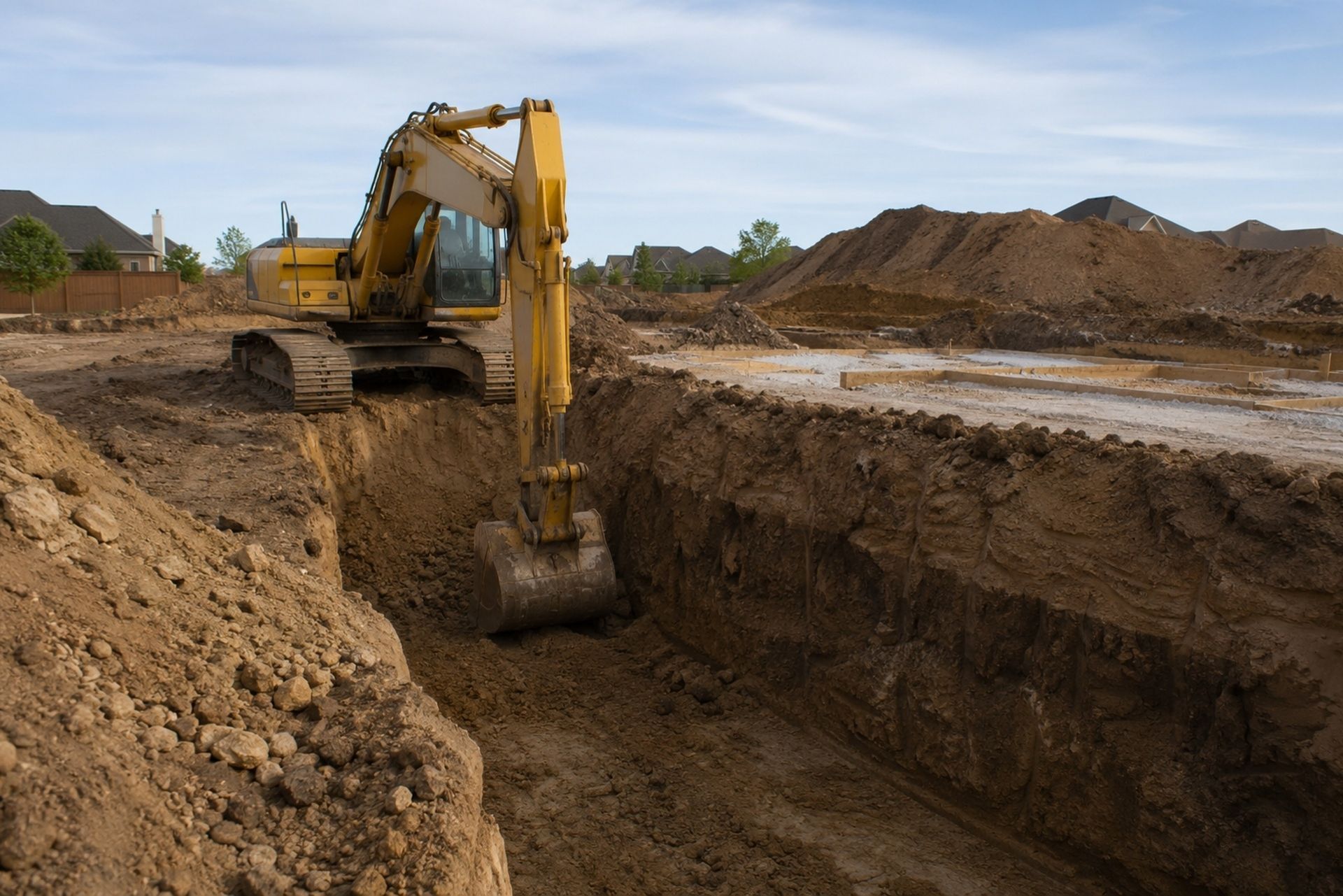
Excavation work is one of the most dangerous trades in construction, and the insurance market knows it. Every time a backhoe breaks ground, there's a real chance of hitting a gas line, destabilizing a foundation, or triggering an environmental incident that spirals into six or seven figures of liability. That risk profile makes excavation contractors insurance notoriously difficult to place. Standard carriers don't want the exposure, and the contractors who need coverage most are often the ones getting declined or quoted premiums that make no financial sense.
If you run an excavation business, you've probably experienced this firsthand: applications returned without explanation, policies loaded with exclusions that gut your actual coverage, or renewals that jump 15% with no claims history to justify it. General liability rates for excavation contractors have surged 12% to 15% year-over-year, driven by rising claim severity and a shrinking pool of willing underwriters. The result is a market that punishes excavation businesses simply for existing. This article breaks down why that happens, what coverage you actually need, and how specialists like GrayStone Insurance Group solve the placement problem.
The High-Risk Nature of Excavation Work
Excavation sits at the intersection of heavy equipment operation, unpredictable ground conditions, and proximity to critical underground infrastructure. Unlike a roofing crew working on a visible surface, excavation contractors operate blind. You're cutting into earth that may contain unmarked utilities, unstable soil layers, contaminated fill, or groundwater that nobody accounted for in the site survey.
The physical danger is matched by the financial exposure. A single utility strike can shut down service to thousands of homes. A trench collapse can result in fatalities and OSHA investigations that drag on for years. These aren't hypothetical scenarios: they're the reason underwriters treat excavation as one of the highest-risk construction classifications.
Subsurface Hazards and Utility Strikes
Even with 811 locate services and ground-penetrating radar, utility strikes remain common. Aging infrastructure maps are often inaccurate, and private utilities like irrigation lines or abandoned septic systems don't show up in public records at all. A contractor in Texas might clip a fiber optic trunk line and face a $400,000 claim from a telecom provider before the dust settles.
Gas line strikes are the ones that keep underwriters up at night. A ruptured natural gas line can cause explosions, evacuations, and wrongful death claims. The average cost of a serious utility strike runs well into six figures when you factor in property damage, service restoration, and third-party injury claims. This single exposure category is enough to make most standard carriers walk away from excavation risks entirely.
Soil Instability and Structural Collapse Risks
Trench collapses kill dozens of construction workers every year in the United States. OSHA's trenching and excavation standards exist because the physics of soil movement are genuinely lethal: a cubic yard of soil weighs roughly 3,000 pounds, and walls can give way without warning.
Beyond worker safety, excavation near existing structures creates enormous third-party liability. Digging a foundation next to a neighboring building can cause settlement cracks, foundation shifts, or outright structural failure. These claims often involve complex engineering disputes and can take years to resolve, with defense costs alone reaching $200,000 or more before a verdict is even reached.
INDEX
GrayStone Insurance Group is fully licensed and permitted to provide specialty commercial insurance solutions for high-risk and hard-to-place businesses across 17 states.
We proudly serve high-risk and hard-to-place businesses from coast to coast. As an independent specialty brokerage, our team works with leading Excess & Surplus and specialty carriers to make sure restaurants, bars, contractors, trucking companies, manufacturers, and other hard-to-place operations receive coverage that fits their real risks in California, Colorado, Florida, Georgia, Illinois, Iowa, Maryland, Michigan, Missouri, Nevada, New York, North Carolina, South Carolina, Tennessee, Texas, Utah, and Washington.
Every policy has boundaries. Knowing them up front is how you avoid an uncovered claim. Common exclusions include:
Every policy has boundaries. Knowing them up front is how you avoid an uncovered claim. Common exclusions include:
Every policy has boundaries. Knowing them up front is how you avoid an uncovered claim. Common exclusions include:
General Liability responds to the core exposures most operations in this category face. A typical policy answers third-party claims and the defense costs that come with them, so a single incident doesn't put the business at risk.
If your firm provides any design, engineering, or consulting services alongside construction, you need both. A GL policy won't cover a claim alleging your design specifications caused a building envelope failure. That's a professional liability exposure, and it's one of the fastest-growing claim categories in construction.
Why Standard Carriers Avoid Excavation Contractors
Standard admitted carriers build their books around predictable, moderate-risk classes. They want landscapers and handymen, not contractors moving 500 cubic yards of earth per day next to a hospital's gas main. The math simply doesn't work for carriers that price based on broad actuarial tables rather than individual risk assessment..
The Severity of Potential Claims
The issue isn't just frequency: it's severity. A slip-and-fall claim at a retail store might settle for $30,000. A utility strike or trench collapse can generate claims exceeding $1 million. When a single loss can wipe out years of collected premium, carriers either decline the risk or price it so high that the contractor can't afford the policy.
Completed operations exposure adds another layer. If an excavation contractor improperly compacts fill material and a building settles three years later, the resulting claim hits the policy that was in force when the work was performed. That long tail of liability makes carriers nervous because they're holding risk for years after the premium was collected.
Restrictive Policy Exclusions to Watch For
Some carriers will write excavation, but the policy they deliver is full of holes. Watch for exclusions on subsurface work, underground utilities, blasting operations, and pollution. A general liability policy that excludes damage to underground utilities is essentially worthless for an excavation contractor: that's the primary risk you face.
Other common restrictions include:
- Depth limitations (no coverage for work below 8 or 10 feet)
- Exclusions for work near existing structures within a specified distance
- No coverage for dewatering operations or groundwater contamination
- Blanket pollution exclusions that eliminate environmental liability
If your policy contains these exclusions, you're paying premium for coverage that won't respond when you actually need it.
The 2026 market has seen property catastrophe rates drop 14.7% in early renewals, which is good news for builders risk. But excess liability premiums have moved sharply in the other direction, with hikes ranging from 7% to well above that depending on the risk profile. Getting the right stack of coverage at the right price requires more than just calling your local agent.
Essential Coverages for Excavation Businesses
Getting insured is only half the battle. Getting the right coverage is what actually protects your business. Too many excavation contractors carry a bare-bones GL policy and assume they're covered, only to discover the gaps after a loss.
Comparison: Basic Liability vs. Comprehensive Protection
| Coverage Element | Basic GL Policy | Comprehensive Program |
|---|---|---|
| General Liability | $1M/$2M with exclusions | $1M/$2M with fewer restrictions |
| Underground Utilities | Typically excluded | Included |
| Pollution Liability | Excluded | Included (claims-made or occurrence) |
| Inland Marine/Equipment | Not included | Scheduled or blanket coverage |
| Completed Operations | Limited or excluded | Full completed ops coverage |
| Excess/Umbrella | Hard to place separately | Packaged with primary layers |
| Professional Liability | Not included | Available for design-build work |
The price difference between these two programs might be 30% to 50%, but the coverage difference is enormous. A comprehensive program actually responds to the claims excavation contractors face.
Inland Marine and Equipment Floaters
Excavators, bulldozers, skid steers, and trenchers represent hundreds of thousands of dollars in mobile assets. Standard commercial property policies don't cover equipment that moves from jobsite to jobsite. You need an inland marine policy or equipment floater that covers theft, vandalism, transit damage, and equipment breakdown.
One detail that catches contractors off guard: rental equipment. If you rent a $300,000 excavator and it's damaged on your jobsite, the rental company's insurance won't cover it. Your inland marine policy or a rental equipment floater needs to pick up that exposure. Without it, you're writing a very large check.
Pollution and Environmental Liability
Excavation work frequently disturbs contaminated soil, encounters underground storage tanks, or causes sediment runoff into waterways. Standard GL policies exclude pollution almost universally. A standalone pollution liability policy covers cleanup costs, third-party bodily injury from contamination, and regulatory defense expenses.
This isn't optional coverage for excavation contractors: it's essential. Environmental cleanup costs can run into millions of dollars, and the contractor who disturbed the contamination often gets named in the enforcement action regardless of who originally caused it. Even if you didn't put the contamination there, you may be legally responsible for releasing it.
Every policy has boundaries. Knowing them up front is how you avoid an uncovered claim. Common exclusions include:
Every policy has boundaries. Knowing them up front is how you avoid an uncovered claim. Common exclusions include:
Every policy has boundaries. Knowing them up front is how you avoid an uncovered claim. Common exclusions include:
General Liability responds to the core exposures most operations in this category face. A typical policy answers third-party claims and the defense costs that come with them, so a single incident doesn't put the business at risk.
The GrayStone Advantage: Specialized Placement
Finding coverage for excavation work requires a broker who understands the risk class and has relationships with carriers willing to write it. GrayStone Insurance Group has built its practice around hard-to-place commercial risks, with brokers averaging 20 years of market experience. That depth of knowledge matters when you're trying to place a $2 million GL policy for a contractor who does deep excavation near urban infrastructure.
Access to Excess and Surplus (E&S) Markets
Most excavation contractors insurance ends up in the excess and surplus lines market, where non-admitted carriers have the flexibility to write risks that standard carriers won't touch. GrayStone maintains relationships with dozens of E&S carriers, which means more options and competitive pricing even for difficult classes.
The E&S market isn't a last resort: it's often the right market for excavation risks. These carriers specialize in complex underwriting and can tailor policy forms to match your actual operations. A surplus lines carrier might write a GL policy that includes underground utility coverage, pollution buyback endorsements, and completed operations coverage that a standard carrier would never offer.
Tailored Risk Management Strategies
GrayStone uses data-driven underwriting intelligence to present your risk in the most favorable light to carriers. That means going beyond the basic ACORD application and documenting your safety programs, equipment maintenance records, training certifications, and loss history in a way that gives underwriters confidence.
A well-prepared submission can mean the difference between a decline and a competitive quote. Carriers want to see that you're using trench boxes, following OSHA competent person requirements, and maintaining current 811 locate protocols. GrayStone's team knows what underwriters look for because they've placed thousands of construction risks and maintain a 94% client retention rate built on getting results.
Why does my insurance keep going up even though I haven't had any claims? Claims in the broader construction industry drive rate increases across the board. Even with a clean loss history, you're affected by market-wide trends like nuclear verdicts and increased material costs that inflate claim values.
Can I save money by classifying workers as subcontractors instead of employees? This is one of the most common and dangerous mistakes contractors make. Misclassification can result in audit penalties, uncovered workers' comp claims, and state fines. If a worker is functionally an employee, treat them as one.
What limits should I carry for general liability? Most commercial contracts require $1M per occurrence and $2M aggregate at minimum, with an umbrella policy bringing total limits to $5M or more. Your specific needs depend on project size and contract requirements.
Do I need a separate policy for each project? Not usually. A practice policy covers all your operations, though large projects may require project-specific coverage or wrap-ups. Your broker should review each contract to determine what's needed.
What happens if my subcontractor's insurance lapses mid-project? You're exposed. Your policy may respond, but you'll likely face a deductible and potential premium increase. Continuous certificate tracking is essential, and many contractors now use automated verification platforms.
How long does completed operations coverage last? Typically tied to your policy period, but statutes of repose vary by state: some allow construction defect claims up to 10 years after completion. Make sure your coverage extends long enough to match your state's statute.
When admitted carriers decline your application, the surplus lines market becomes your path to coverage. Surplus lines insurers aren't bound by the same rate and form regulations as admitted carriers, giving them flexibility to write policies for unusual or high-hazard risks. The U.S. surplus lines market has grown substantially as more businesses find themselves unable to secure standard market coverage.
Working with a broker who has established surplus lines relationships is critical. GrayStone Insurance Group, for example, specializes in placing coverage for hard-to-place contractors through its surplus lines partnerships, using data-driven risk modeling to match operators with the right carrier. Not every surplus lines broker understands construction, so look for one with specific trade experience.
Navigating the Surplus Lines Market
Impact of Claims History on Future Premiums
Your loss history follows you. A single large claim can increase premiums for three to five years, and multiple claims within a short window can make you virtually uninsurable in the standard market. Your experience modification rate (EMR) in workers comp directly reflects your claims history relative to peers in your classification.
The good news: you can improve your EMR over time by reducing claim frequency and severity. Implement return-to-work programs, contest questionable claims, and invest in loss control. Brokers with deep industry knowledge, like those averaging 20+ years of experience at firms such as GrayStone, can help you build a narrative around your risk improvement efforts that resonates with underwriters.
Start with your safety program. Documented training, proper PPE protocols, and a clean claims history are the fastest path to lower premiums. Beyond that, working with a broker who understands risk assessment for specialty construction trades can help you avoid overpaying for coverage you don't need while making sure you're not exposed on the coverages you do.
Bundling your GL, inland marine, and commercial auto with a single carrier or program often yields better pricing than buying each separately. Raising your deductible from $1,000 to $2,500 can also reduce premiums by 10-15% on general liability.
FAQ: How can I lower my insurance costs without losing coverage?
What This Means for Your Business
Concrete finishing is a skilled trade that deserves insurance coverage designed for its actual risks, not a generic contractor policy with half the important coverages stripped out. The difficulty in placing this insurance isn't a reflection of your business: it's a reflection of a market that doesn't understand your trade well enough to price it fairly.
If you're paying too much, carrying policies with critical exclusions, or getting declined altogether, the problem is almost certainly your current broker's market access, not your operation. GrayStone Insurance Group specializes in exactly these hard-to-place risks, connecting concrete contractors with carriers who actually want to write this business.
The right policy protects your equipment, your completed work, your crew, and your reputation. Don't settle for less just because a few carriers said no. Reach out to GrayStone and get a quote built around what your concrete business actually does.
Common Questions About Excavation Insurance
How much does general liability cost for an excavation contractor? Expect to pay between $8,000 and $25,000 annually for a $1M/$2M GL policy, depending on your revenue, location, loss history, and specific operations. Deep excavation and urban work push premiums higher.
Do I need pollution liability if I only dig residential foundations? Yes. Residential properties can have old heating oil tanks, lead paint debris, or contaminated fill. One unexpected discovery can trigger cleanup obligations that your GL policy won't cover.
Can I get coverage if I've had claims in the past three years? You can, but your options narrow significantly. A specialist broker can place coverage in the E&S market even with adverse loss history, though you'll likely pay higher premiums and carry larger deductibles.
What's the difference between admitted and non-admitted carriers? Admitted carriers are regulated by your state's insurance department and backed by guaranty funds. Non-admitted (surplus lines) carriers have more underwriting flexibility but aren't backed by state guaranty funds. For excavation risks, surplus lines carriers are often the only realistic option.
Does my workers' compensation policy cover trench collapses? Workers' comp covers employee injuries regardless of cause, including trench collapses. But it doesn't cover third-party claims, property damage, or OSHA fines. You need GL and potentially an umbrella policy for those exposures.
Every policy has boundaries. Knowing them up front is how you avoid an uncovered claim. Common exclusions include:
Every policy has boundaries. Knowing them up front is how you avoid an uncovered claim. Common exclusions include:
Every policy has boundaries. Knowing them up front is how you avoid an uncovered claim. Common exclusions include:
General Liability responds to the core exposures most operations in this category face. A typical policy answers third-party claims and the defense costs that come with them, so a single incident doesn't put the business at risk.
Before You Buy a Policy
Excavation contractors face a genuinely difficult insurance market, and that reality isn't changing anytime soon. Claim severity keeps climbing, carriers keep tightening their appetites, and the contractors who don't work with specialized brokers end up either uninsured or underinsured.
The single most important thing you can do is read your policy before you need it. Check for underground utility exclusions, pollution exclusions, depth limitations, and completed operations restrictions. If your current policy has those gaps, you're carrying risk you think is covered but isn't.
GrayStone Insurance Group specializes in placing coverage for exactly these situations. If you're tired of declinations and restrictive policies, reach out for a coverage review. The right broker doesn't just find you a policy: they find you protection that actually works when a claim hits.
ABOUT THE AUTHOR:
CHAD KRAMER
I started GrayStone Insurance Group in 2018 with a simple conviction: the businesses everyone else turns away deserve a broker who won't. What began as a one-person operation has grown into a specialty commercial brokerage with offices across the country — but the mission hasn't changed. We find solutions for high-risk and hard-to-place businesses when other agencies run the other way.
I built this agency on integrity, hard work, and the tenacity to do the hard things well. Through our access to Excess & Surplus and specialty markets, my team and I place coverage standard carriers can't — and I treat every client's business like my own.
If you've been declined, non-renewed, or told your business is too complicated to insure, let's talk.
Coverages & policies
Plain-language coverage, expertly placed.
We lead with commercial lines and round out personal coverage where you need it. Every policy comes with an explanation — not jargon.

Contractors
Third-party bodily injury & property damage — the foundation for any operation.

Liquor Liability
Critical for bars, restaurants and venues serving alcohol — including A&B.

Commercial Property
Buildings, contents and equipment — including distressed and vacant risk.

Workers' Compensation
Statutory coverage for your crew — including high-mod and high-hazard classes.

Commercial Umbrella
Extra liability limits over your primary policies — essential for high-exposure risk.
Products Liability
Manufacturers, CBD and consumer-product exposure — including imports.
What clients say
Brokers who actually place it.
FAQ
Answers for the risks others won't cover
Getting declined, non-renewed, or told your business is "too high-risk" is frustrating — but it doesn't mean you're out of options. Here are answers to the questions we hear most from business owners who need coverage the standard market won't provide.
What kind of insurance does GrayStone specialize in?
We're a specialty commercial brokerage built for high-risk and hard-to-place businesses — the risks standard carriers often turn away. Through our access to Excess & Surplus (E&S) and specialty markets, we place coverage that everyday agencies can't. Hospitality and construction are among our deepest areas of expertise.
My business was declined or non-renewed elsewhere. Can you still help?
That's exactly what we do. A decline, a non-renewal, or a tough claims history doesn't mean you're out of options — it means your risk needs a broker with the right market access. Tell us your situation and we'll get to work finding a fit.
What is Excess & Surplus (E&S) insurance?
E&S is specialty coverage for risks that standard "admitted" carriers won't write — often because a business is higher-risk, unusual, or has a complex history. As an independent broker, we tap into these specialty markets to place coverage where a typical agency hits a dead end.
What industries do you work with?
We cover a wide range of commercial industries — from restaurants, bars, and hospitality to contractors, trucking, manufacturing, cannabis, and more. If your industry is considered high-risk or hard-to-place, there's a good chance we've handled it.
Will you work with businesses that have prior claims or losses?
Yes. Prior claims and losses are part of many of the risks we place every day. Every business is evaluated on its own merits — and a rocky history is often exactly why a specialty broker can help where others won't.
Are you an independent broker?
Yes. We're not tied to a single carrier, so we shop your risk across multiple specialty and E&S markets to find coverage that actually fits — instead of forcing you into a one-size-fits-all policy.
Insights & resources
Know your risk before you buy.