

PA single uninsured assault claim can easily reach $250,000 to $500,000 when you factor in medical expenses, legal defense, lost wages, and pain-and-suffering damages. Jury awards in nightclub assault cases have exceeded seven figures with increasing frequency. Without A&B coverage, those costs come directly out of your business assets, and for most bar owners, that means closing the doors permanently.
The Role of the Customer's Personal Auto Policy
A restaurant owner closing for a six-week kitchen overhaul probably has a hundred things on their mind: permits, contractor bids, new equipment specs, timeline pressure. Insurance rarely makes the top ten. That's a mistake that can cost more than the renovation itself.
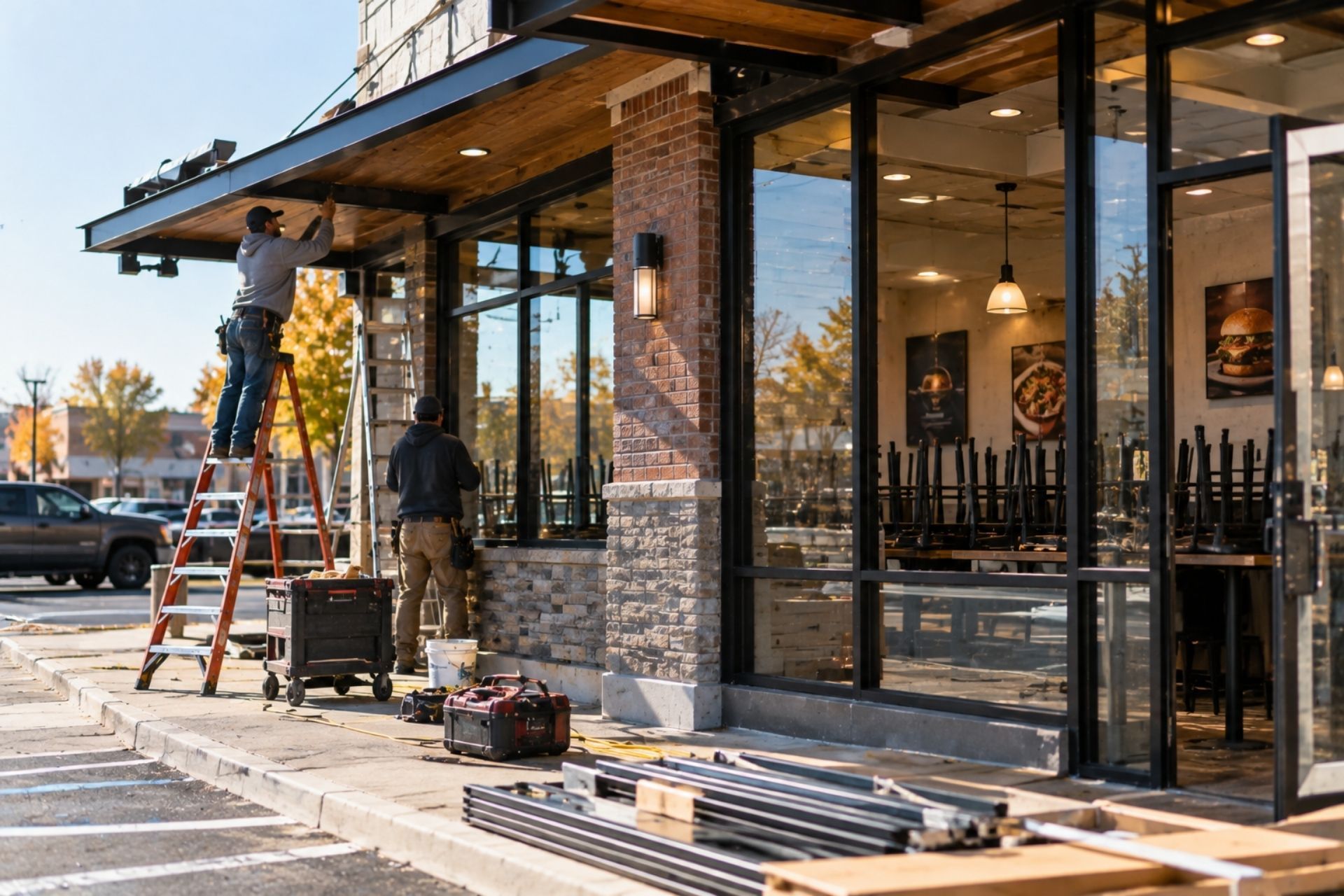
The gap between your standard restaurant policy and the coverage you actually need during construction is wider than most people realize. Your existing policy was designed for a functioning restaurant with staff on-site, customers coming and going, and equipment in regular use. The moment you shut the doors, gut the kitchen, and invite a demolition crew inside, the risk profile of your building changes completely. Your insurer knows this, even if you don't.
Getting the right insurance coverage for a restaurant renovation during a temporary closure isn't glamorous work, but it's the difference between a smooth reopening and a financial disaster. A single burst pipe, a contractor's mistake with a torch, or a slip-and-fall on an exposed subfloor can wipe out your renovation budget and then some. Here's what you need to know before the first sledgehammer swings.
Why Standard Restaurant Insurance Isn't Enough During Renovations
Most restaurant owners assume their existing commercial property and general liability policies will cover them through a renovation. That assumption falls apart fast when you read the fine print. Standard policies are underwritten based on your normal operations: food prep, customer dining, liquor service. A construction zone is a fundamentally different risk, and insurers treat it that way.
The Vacancy Provision Trap
Nearly every commercial property policy includes a vacancy clause, and this is where restaurant owners get blindsided. If your building sits unoccupied for 60 consecutive days (the standard threshold in most policies), your coverage can be reduced by as much as 15%, or certain perils like vandalism, sprinkler leakage, and glass breakage may be excluded entirely. Some policies define "vacant" differently from "unoccupied," but the practical result is the same: if your restaurant is closed and nobody is conducting normal business operations inside, you're at risk of triggering this clause.
A six-to-eight-week renovation puts you right on the edge of that 60-day window. Delays push you over it. And once the vacancy provision kicks in, you may not even realize your coverage has been slashed until you file a claim.
Increased Risks During a Temporary Closure
The irony is that your building faces more hazards during renovation than during normal operations. Open walls expose wiring and plumbing. Contractors use torches, saws, and welding equipment. Dust and debris create fire hazards. Theft risk spikes because construction sites are targets for copper and equipment theft, especially in unoccupied buildings overnight. Water damage from disconnected plumbing is
one of the most common claims during renovations, and a standard property policy may not cover it if the building is considered vacant or if the damage resulted from construction activity.
Essential Coverage Types for Renovating Owners
Closing your restaurant for renovations doesn't mean you need fewer insurance policies. You probably need more. The specific coverages depend on the scope of your project, but a few are non-negotiable for any significant renovation.
Builders Risk Insurance for Physical Assets
Builders risk insurance is the backbone of renovation coverage. It protects the building structure, materials on-site, and work in progress against fire, wind, theft, vandalism, and other covered perils. For commercial renovations, builders risk typically costs between 1.80% and 3.50% of the total project value. On a $250,000 kitchen renovation, that translates to roughly $4,500 to $8,750 for the policy term.
One thing to keep in mind: builders risk policies can also include soft costs coverage, which reimburses expenses like additional interest payments, permit fees, and extended overhead if the project runs past its deadline. These costs add up quickly when a renovation drags on, and they're exactly the kind of expense that falls through the cracks of a standard policy.
Premises Liability for Construction Hazards
Even though your restaurant is closed to the public, people are still entering the building: contractors, subcontractors, inspectors, delivery drivers, maybe a curious neighbor. If someone gets hurt on your property during renovation, you need premises liability coverage that specifically accounts for construction hazards. Your standard general liability policy may have exclusions for injuries related to construction activity, so confirm this with your broker before work begins.
Equipment Breakdown and Installation Floaters
New commercial kitchen equipment is expensive, and it's vulnerable during the installation phase. An installation floater covers your new equipment from the moment it leaves the supplier until it's fully installed and operational. This fills the gap between your equipment supplier's responsibility and your standard business property coverage. If a $40,000 combi oven gets damaged during installation, you don't want to discover that neither your property policy nor the contractor's insurance covers it.
Comparing Active Operations vs. Renovation Coverage
Understanding how your insurance needs shift during a renovation helps you spot the gaps before they become claims. The differences are significant enough that treating a renovation like "business as usual" from an insurance standpoint is one of the most common and costly mistakes restaurant owners make.
Comparison Table: Standard Policy vs. Renovation Endorsements
| Coverage Area | Standard Restaurant Policy | Renovation Period Coverage |
|---|---|---|
| Property damage | Covers building and contents during normal use | Builders risk covers structure, materials, and work in progress |
| Liability | Customer slip-and-fall, foodborne illness | Premises liability for construction hazards |
| Equipment | Covers installed, operational equipment | Installation floater for equipment in transit and during install |
| Business income | Covers lost income from covered perils | May need separate endorsement; soft costs coverage handles delay expenses |
| Vacancy restrictions | 60-day vacancy clause applies | Builders risk has no vacancy exclusion |
| Theft | Covers theft with building security | Builders risk covers material and equipment theft on-site |
| Workers comp | Covers your restaurant employees | Contractor carries their own; you may still need coverage for retained staff |
Managing Contractor Risks and Certificates of Insurance
Your general contractor's insurance is not your insurance. This is a point that trips up a lot of restaurant owners. Just because a contractor has coverage doesn't mean you're protected if something goes wrong on your property during their work.
Verifying General Contractor Coverage
Before any contractor starts work, require a certificate of insurance showing current general liability (minimum $1M/$2M is standard), workers compensation, and auto liability if they're transporting materials. Don't just glance at the certificate: verify that the policy dates cover your entire project timeline, including potential delays. Call the insurer listed on the certificate to confirm it's active. GrayStone Insurance Group's brokers, with an average of 20 years in the industry, routinely catch expired or inadequate contractor certificates that would leave restaurant owners exposed.
Also verify that your contractor carries their own builders risk policy or that your policy names them as an insured party. Overlapping coverage is better than a gap.
Naming the Restaurant as an Additional Insured
Require every contractor and subcontractor to add your restaurant (and your LLC or corporate entity) as an additional insured on their general liability policy. This gives you direct rights under their policy if a claim arises from their work. Without this endorsement, you'd have to sue the contractor to access their coverage, which is expensive and slow. The additional insured endorsement costs the contractor very little, and any reputable contractor will provide it without pushback. If they refuse, that's a red flag.
Common Questions About Restaurant Renovation Coverage
Do I need to tell my agent if I'm closing for two weeks?
Yes, always. Even a short closure changes your risk profile, and failing to disclose it could give your insurer grounds to deny a claim. A two-week closure for cosmetic updates may not require additional policies, but your agent needs to know so they can confirm your existing coverage remains valid. This is especially true if you're dismissing staff, shutting off utilities, or allowing contractors on-site.
Does my regular fire insurance work while the kitchen is gutted?
It might, but with serious limitations. If a fire starts due to construction activity like welding, soldering, or electrical work, your standard property policy may exclude the claim or reduce payout under the vacancy provision. Builders risk insurance specifically covers fire during construction, including fires caused by hot work. Given that restaurant properties carry elevated fire risk even under normal conditions, this coverage gap is too dangerous to ignore.
Can I pause my workers comp while we are closed?
Only if you have zero employees on payroll. If you're keeping any staff, even a manager checking on the building or handling administrative work, you need active workers comp. Some states impose penalties for letting coverage lapse, and reinstating a lapsed policy often triggers an audit. Talk to your broker about adjusting your payroll estimates downward during the closure instead of canceling outright.
What happens if a pipe bursts while no one is in the building?
This is one of the most expensive scenarios during a renovation because water damage compounds over time. If nobody discovers the burst for days, you could be looking at tens of thousands in damage to new materials, flooring, and drywall. Your standard property policy may deny the claim if the building is vacant or if the pipe burst resulted from construction activity. Builders risk typically covers this, but you should also install water leak sensors and have someone check the building daily.
Business interruption coverage can help offset the financial impact of extended delays caused by water damage.
Making the Right Choice Before Construction Starts
The worst time to think about insurance for a restaurant renovation is after something goes wrong. The second worst time is the week before construction begins, when you're scrambling to get certificates and endorsements in place.
Start the insurance conversation at least 30 days before your planned closure. This gives your broker time to review your existing policies, identify gaps, obtain builders risk quotes, and coordinate with your contractor's insurance. If you're working with a firm like GrayStone Insurance Group that specializes in hard-to-place commercial risks, their AI-powered risk modeling can flag exposures specific to your renovation scope and building type, things a generalist agent might miss entirely.
Here's the honest bottom line: renovation insurance for a temporarily closed restaurant isn't one policy. It's a coordinated set of coverages that work together to protect your building, your new investment, your liability exposure, and your reopening timeline. Builders risk, premises liability, installation floaters, additional insured endorsements, and business interruption coverage each fill a specific gap that your standard restaurant policy wasn't designed to cover.
The cost of assembling this coverage is a fraction of a single uninsured claim. Get it right before the first wall comes down, and you'll reopen with your finances intact and your stress levels a lot more manageable.
Search
INDEX
ABOUT THE AUTHOR:
CHAD KRAMER
I started GrayStone Insurance Group in 2018 with a simple conviction: the businesses everyone else turns away deserve a broker who won't. What began as a one-person operation has grown into a specialty commercial brokerage with offices across the country — but the mission hasn't changed. We find solutions for high-risk and hard-to-place businesses when other agencies run the other way.
I built this agency on integrity, hard work, and the tenacity to do the hard things well. Through our access to Excess & Surplus and specialty markets, my team and I place coverage standard carriers can't — and I treat every client's business like my own.
If you've been declined, non-renewed, or told your business is too complicated to insure, let's talk.
