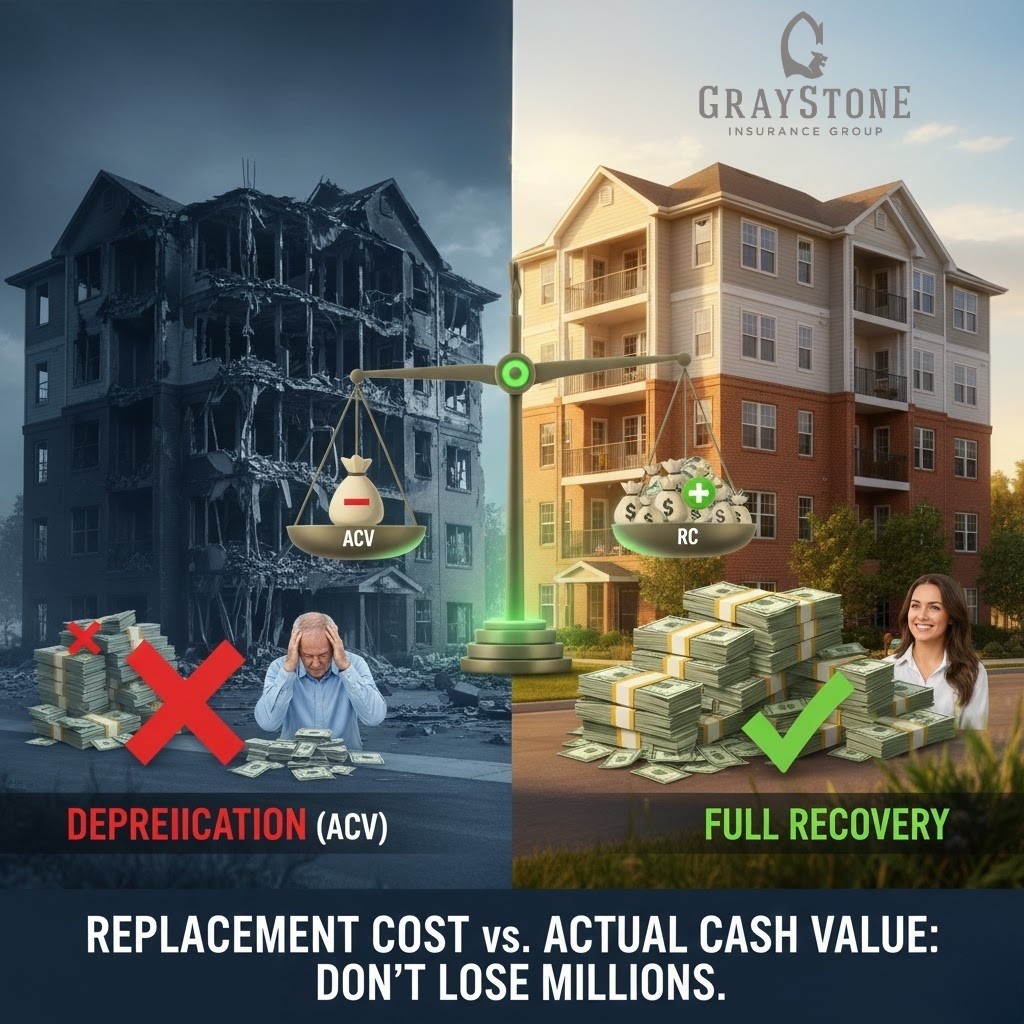
The difference between Replacement Cost (RC) and Actual Cash Value (ACV) can cost property owners millions. Here are the most critical actions and facts to remember from the article to ensure a full financial recovery after a disaster:
1. Always Choose Replacement Cost (RC)
RC is the only policy that guarantees you will receive enough money to rebuild your property with brand-new materials without having to pay the difference yourself. ACV is a “dangerous gamble” that saves a small amount on premiums but risks millions in rebuilding costs.
2. Understand the Depreciation Gap
ACV subtracts money for depreciation (age and wear). This creates a massive depreciation gap that the property owner is forced to cover out of pocket. Crucially, your bank or mortgage lender will always require you to rebuild with new materials, regardless of your ACV payout.
3. Avoid the Coinsurance Penalty
The Coinsurance Penalty is a severe fine applied if you are underinsured. It forces you to share the loss with the insurance company, even if the claim is small. This penalty is based on the building’s Full Replacement Cost, not its lower ACV.
4. Get an Annual Valuation
The single most important step to prevent underinsurance and the Coinsurance Penalty is to obtain a professional Reconstruction Cost Estimate (RCE) every single year. Construction costs are rising, and an outdated valuation will trigger a penalty.
5. Require Two Critical Endorsements
For maximum protection, ensure your policy includes:
When a fire, flood, or bad storm hits your apartment complex, you face the biggest question: How much money will your insurance company actually give you to rebuild? This choice—between Replacement Cost (RC) and Actual Cash Value (ACV)—is the most important one you will make. It decides if you get enough money for a full financial recovery or if you have to spend millions of dollars from your own savings to fix your property.
GrayStone Insurance Group helps clients set up commercial property insurance policies that always use the Full Replacement Cost. We teach apartment owners why choosing the cheaper option (ACV) to save a little money on the yearly bill is a huge financial mistake for big buildings. Your ability to recover completely depends on this single decision in your policy.
What is Replacement Cost (RC) insurance and why is it the gold standard for apartment complexes?
Replacement Cost (RC) is the amount of money needed to rebuild or replace damaged property with all new materials. It pays for the current, full price of everything, without taking off money for how old or worn out the item was. RC is the best choice because it lets the property owner recover 100% of the cost to bring the building back to its original, perfect condition.
RC coverage is the only way a property owner can be sure the complex will be rebuilt using modern standards and brand-new materials, no matter how old the building was before the damage. This guarantee for a full, new restoration is what truly protects the value of your large investment.
A. How RC Payouts Work
The insurance company usually does not send you a check for the full RC amount immediately. The payment process is set up in two easy steps:
B. RC and Inflation/Demand
RC is very important in growing areas where the price of materials and labor goes up quickly. If a major disaster happens, the demand for builders can soar. RC makes sure your insurance pays based on those current, high prices right after the loss, not the lower prices from two years ago when you bought the policy. This is why the Inflation Guard rule is so important—it automatically increases your policy’s RC limit over time to keep up with rising costs, helping you avoid being underinsured later.
What is Actual Cash Value (ACV) insurance and what is the risk of choosing it?
Actual Cash Value (ACV) is defined as the Replacement Cost minus depreciation (the money taken off because the item was old, used, and worn out). The risk of choosing ACV is simple: the insurer will only pay a fraction of the total rebuild cost. This leaves the owner responsible for the often huge difference, which can make rebuilding the complex impossible without using private funds.
A. The Definition of Depreciation
Depreciation is the amount the value of your property goes down because of age and use. Insurance companies figure out depreciation based on how long a component (like a roof or a heating system) was expected to last.
For example:
B. The Primary ACV Pitfall (Unintended Underinsurance)
Owners often choose an ACV policy because it costs a little less money each year. However, this small saving leads to huge underinsurance when a claim happens. Owners often forget one crucial fact: the bank or mortgage lender requires the property to be rebuilt with new materials, no matter what your ACV policy pays.
The owner is then forced to pay the huge missing amount (the depreciation gap) using their personal savings or by taking out expensive loans. For a large apartment complex, this gap can easily be millions of dollars, turning a problem that should have been solved by insurance into a financial disaster.
What is the Coinsurance Penalty and how can it drastically reduce my claim payout?
The Coinsurance Penalty is a rule that says the property owner must buy insurance limits that equal a certain percentage (usually 80% or 90%) of the total Full Replacement Cost of the entire building. If the owner breaks this rule by insuring the building for too little, the insurance company can legally cut the claim payout by the same percentage, forcing the owner to share the loss. This is like a massive fine for underinsuring.
A. The Coinsurance Formula Explained (Simply)
This penalty is applied to the money the insurer pays out. A simple rule is used to figure out the final check amount:
Final Check = (Amount You Insured For / Amount You Should Have Insured For) x Loss Amount
For example, imagine your building’s true Full Cost to Rebuild is $10 million, and your policy requires 80% coverage (meaning you must insure for $8 million). If you only buy $5 million in coverage, you are underinsured. Even if a fire only causes a $1 million loss, the payment is cut:
The owner must pay the remaining $375,000 of the loss, plus their deductible.
B. The Danger of Outdated Valuations
The number one reason people get hit with the Coinsurance Penalty is using an old valuation estimate. Construction costs rise every year. If a property was worth $10 million five years ago but is now valued at $12 million due to higher construction costs, and you are still insured for $10 million, you are violating the rule and face a severe fine on every claim. You must get a new building estimate every year.
C. The ACV/Coinsurance Double Whammy
Choosing ACV creates a terrible double trap: you still must meet the Coinsurance rule based on the Full Replacement Cost of the property, not the lower ACV. You save a small amount on the premium, but you lose the ability to rebuild with new funds and get hit with the Coinsurance fine for underinsuring against the Full Replacement Cost. This combination can be devastating.
What are the three core steps to ensure I have true Replacement Cost coverage?
To guarantee you get a full financial recovery, GrayStone recommends three core pillars: Accurate Valuation (using a current Reconstruction Cost Estimate), Guaranteed Replacement Cost (a premium policy feature), and Business Income Coverage (to replace lost rent during reconstruction).
A. Accurate Reconstruction Cost Valuation
A professional Reconstruction Cost Estimate (RCE) must be done every year. This is not the same as a simple property appraisal (which includes land value). The RCE looks only at the current, local costs for:
By knowing this exact cost, you make sure your insurance limit meets the Coinsurance rule and provides the money you need for a full rebuild.
B. Guaranteed Replacement Cost (GRC) Endorsement
This is one of the strongest endorsements you can buy. Guaranteed Replacement Cost (GRC) ignores the policy limit if the total cost of rebuilding goes over the amount you were insured for. For instance, if you were insured for $10 million, but sudden inflation pushes the rebuild cost to $12 million, GRC covers that extra $2 million. This is the strongest protection against massive, unexpected costs or new building codes.
C. Business Income/Loss of Rents Coverage
Even with perfect RC coverage, you have a financial problem if your property is destroyed and takes 18 months to rebuild. During that time, you get no rent money but still have to pay expenses like the mortgage, taxes, and bills. Business Income coverage (or Loss of Rents) replaces the lost rental money while the property is being rebuilt, making sure you can keep paying your ongoing bills.
This section answers the most common questions about commercial property insurance valuation, drawing directly from the article, “Understanding Replacement Cost vs. Actual Cash Value for Apartment Complexes.”
Q1: What is the main difference between Replacement Cost (RC) and Actual Cash Value (ACV)?
A: The difference is depreciation (age and wear).
Q2: Why is Replacement Cost (RC) the “gold standard” for my apartment complex?
A: RC is the best choice because it is the only way to guarantee you recover 100% of the cost needed to restore your building. If you have RC, you can be sure the complex will be rebuilt using modern standards and all brand-new materials, regardless of how old the building was before the loss.
Q3: How is the money paid out if I have Replacement Cost (RC) coverage?
A: The insurance company usually pays you in two steps:
Q4: What is “depreciation” and how does it create a financial problem with ACV?
A: Depreciation is the money that is taken off the claim because the damaged item (like a roof or HVAC unit) was old and used. If a roof costs $100,000 to replace but was 50% depreciated, an ACV policy only pays $50,000. You must pay the missing $50,000 yourself. This is the depreciation gap.
Q5: What is the Coinsurance Penalty?
A: The Coinsurance Penalty is a rule that forces you to insure your property for a certain percentage (usually 80% or 90%) of its total Full Replacement Cost. If you fail to buy enough insurance (if you are “underinsured”), the insurance company can legally cut your claim payment. This is like a massive fine for not insuring for the right amount.
Q6: How can I avoid the Coinsurance Penalty and financial fines?
A: The most important way to avoid this penalty is to get a professional Reconstruction Cost Estimate (RCE) done every year. You must make sure the amount you insure your building for matches the RCE. If construction costs have increased in your area, you need to increase your policy limit immediately to stay above the 80% or 90% threshold.
Q7: What are the three core pillars of protection GrayStone recommends for full recovery?
A: To guarantee a full financial recovery, you need:
Q8: What is Guaranteed Replacement Cost (GRC) and why is it so strong?
A: GRC is the strongest endorsement you can buy because it removes the policy limit if the total rebuild cost exceeds the amount you were insured for. For instance, if you were insured for $10 million, but inflation pushes the rebuild cost to $12 million, GRC covers that extra $2 million, protecting you from massive, unexpected costs.
Q9: Why is Loss of Rents coverage just as important as the building coverage?
A: If your apartment complex is destroyed, it might take over a year to rebuild. During that time, you receive no rent money, but you still have to pay expenses like the mortgage, taxes, and bills. Loss of Rents coverage replaces that missing rental income, making sure you can keep paying your ongoing financial obligations while your property is being restored.
For apartment complex owners, the choice is clear: Always insure for Full Replacement Cost. Choosing Actual Cash Value is a small saving that risks the total loss of your most valuable asset. Protecting your income through Loss of Rents coverage while you rebuild is equally important to stay financially safe.
Do not rely on old tax forms or outdated estimates. Work with a commercial specialist who deeply understands the Coinsurance rule and the true cost of rebuilding in your local market. Your financial future depends entirely on this single policy decision.
Contact GrayStone Insurance Group today for a full check of your current policy and a fresh Reconstruction Cost Estimate. We will help you ensure your coverage is sufficient for a full recovery after any disaster.
